
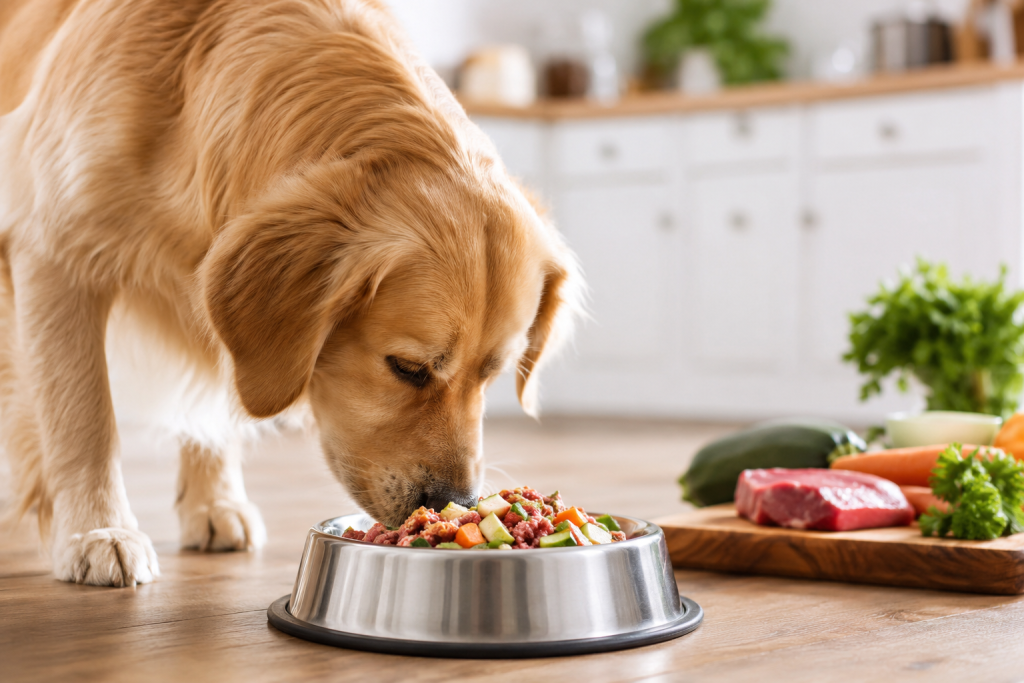
The most common question pet owners ask me is “WHAT should I feed my pet?”, which is answered in our previous blog post here. The second question is then “How MUCH do I need to feed?” When using kibble or canned diets, many owners are used to measuring food by cups or cans. Unfortunately, that technique doesn’t translate well to whole-food diets, so we need to use percentage of body weight instead.
In addition to your pet’s food and a nice clean bowl, you will also need a kitchen scale or gram scale (commonly found online or in grocery stores). This helps to weigh out food in ounces (or grams). After a while, most owners can “eyeball” the correct amount (e.g. 12 ounces is “half” of the dog’s food bowl), but it is always better to start off with a scale until you’re confident.
FOOD MATH
Adult dogs generally need to eat 2-3% of their body weight per day. This can vary slightly depending on factors like age, activity level, lifestyle, and breed. Large-breed dogs should aim for closer to 2% of their body weight per day in food (and 1.5% in giant breed dogs), because they tend to have a slower metabolism. Smaller breeds will need closer to 2.5-3% per day.
There is no fast, easy rule for feeding – just like humans, each dog will have a different metabolism and slightly different nutritional requirements. Routinely monitoring of body weight and Body Condition Score (BCS) will help tailor feeding amounts, and your vet can also help further refine this based on your dog’s specific nutritional needs.
The chart below is derived from Dr. Morgan’s cookbook Yin and Yang Nutrition for Dogs, and can help find a starting point for your dog. These amounts are PER DAY – so if you are feeding 2 or 3 meals per day, you will need to divide this amount by 2 or 3 to calculate the amount of food per meal.
It is important to note that the 2-3% rule is based on IDEAL body weight – which is not always the CURRENT body weight. This is especially important for overweight dogs, as we don’t want to feed them for their overweight or obese weight, but rather, for their IDEAL body weight. If you’re not sure about your dog’s ideal weight, this blog on Body Condition Score (BCS) may be helpful, and discussing it with your vet is always a good plan!
FEEDING CHART BASED ON PERCENTAGE BODY WEIGHT FOR DOGS
| IDEAL WEIGHT | 2% OF WEIGHT | 3% OF WEIGHT | WHERE TO START |
| 5 lbs | 1.6 ounces | 2.4 ounces | Closer to 3% |
| 10 lbs | 3.2 ounces | 4.8 ounces | Closer to 3% |
| 15 lbs | 4.8 ounces | 7.2 ounces | Closer to 3% |
| 20 lbs | 6.4 ounces | 9.6 ounces | Closer to 3% |
| 25 lbs | 8.0 ounces | 12.0 ounces | Closer to 3% |
| 30 lbs | 9.6 ounces | 14.4 ounces | Closer to 3% |
| 35 lbs | 11.2 ounces | 16.8 ounces | Between 2-3% |
| 40 lbs | 12.8 ounces | 19.2 ounces | Between 2-3% |
| 45 lbs | 14.4 ounces | 21.6 ounces | Between 2-3% |
| 50 lbs | 16.0 ounces | 24.0 ounces | Between 2-3% |
| 55 lbs | 17.6 ounces | 26.4 ounces | Between 2-3% |
| 60 lbs | 19.2 ounces | 28.8 ounces | Between 2-3% |
| 65 lbs | 20.8 ounces | 31.2 ounces | Between 2-3% |
| 70 lbs | 22.4 ounces | 33.6 ounces | Closer to 2% |
| 75 lbs | 24.0 ounces | 36.0 ounces | Closer to 2% |
| 80 lbs | 25.6 ounces | 38.4 ounces | Closer to 2% |
| 85 lbs | 27.2 ounces | 40.8 ounces | Closer to 2% |
| 90 lbs | 28.8 ounces | 43.2 ounces | Closer to 2% |
| 95 lbs | 30.4 ounces | 45.6 ounces | Closer to 2% |
| 100 lbs | 32.0 ounces | 48.0 ounces | Closer to 2% |
Example 1: a 30 lb dog (ideal body weight – BCS 5/9) who eats 2 meals per day:
- First, we calculate 2-3% of body weight = 9.6-14.4 ounces per day
- Since this is on the “smaller dog” side of the scale, we should start with 12-14 ounces per day (closer to 3% column)
- Divide 12-14 ounces by 2 to get the total ounces per meal = ~6-7 ounces per meal
Example 2: a 100 lb dog who’s overweight (BCS 7/9) who eats 2 meals per day:
- Since this dog is a bit on the heavy side (and should weigh closer to 90 lbs), we want to use the ideal body weight (90 lb) to calculate
- 2-3% of ideal body weight (90 lbs) = 30.4-45.6 ounces per day
- Since this is on the “larger dog” side of the scale, we should start with 30-36 ounces per day (closer to 2%)
- Divide 32-36 ounces by 2 to get the total ounces per meal = ~15-18 ounces per meal
If you are still confused about the 2-3% rule, this blog has a feeding calculator that will help!
When starting on a whole-food diet, transitioning from processed foods, it is not uncommon to see a few changes:
- Slight weight loss – Some pets lose a bit of weight during the first few weeks on a whole food diet. If this occurs, it typically corrects itself within 4-6 weeks. It should not be more than 10% of the body weight (for example, a 50 lb dog should not lose more than 5 lbs). If your dog loses more than 10% of its initial body weight AND/OR it lasts more than 4-6 weeks, please check in with your vet
- Stool changes – The fillers and by-products of processed diets often lead to large-volume stools. Whole food diets have very high digestibility, so there is less waste passed through the GI tract. This can result in smaller, firmer, denser stools and sometimes less frequent bowel movements. Without the AGEs of processed foods disrupting the GI microbiome, healthy bacteria are able to grow and flourish, leading to improved digestibility and overall GI health. This can also cause changes in stool consistency and a reduction in gas/flatulence.
- Appetite improvement – A lot of “picky eaters” may be dogs who know that eating processed foods don’t “feel good”, so they are reluctant to eat those diets. But many of these dogs regain a healthy appetite once offered whole, fresh foods, and actually enjoy meal times!
A NOTE ABOUT PUPPIES…
Puppies need approximately double the amount of food as an adult of the same size, so we aim to feed 5-6% of their ideal body weight per day. This is spread over 3-4 meals per day during the first few months of life, and is reduced to 2-3 meals per day as they get closer to 6 months old. As puppies approach skeletal maturity, we reduce their total daily food amount from 5-6% to 2-3% body weight, so that once they are skeletally mature (aka, “adults”) they are eating the 2-3% adult portion of food. Feeding puppies under 6 months of age should always be done in close cooperation with your veterinarian and adjusted based on the individual needs of your puppy.
Hopefully, this has helped answer some questions about what to feed and how much to feed!